“Hello Simon, I liked reading about this blog post. I thought it was a cool addition to have supporting evidence when talking about what it means to have tools that allow further accessibility to better suit people’s needs. I think that you could’ve taken it a bit further when you discussed creating a learning environment towards the end. You introduced a great idea about accessibility and how it shapes clarity, choice, and control of the learner, but maybe expanding on how these principles influence learning environments would make your reflection even stronger. However, the examples you provided showed how these ideas connect to UDL designs and inclusivity. I think the examples you provided made the concepts practical and relatable. You did a great job overall though”
“Hey Evelyn, I liked how you said that everyone needs an equal opportunity for education and address the gaps in differences in order to accommodate the students. Great addition of introducing what UDL was and where it came from and what we’ve discussed so far in class. Moreover, it was a good idea to mention how multimedia theories aren’t always about text or caption, but it is about recognizing and giving representation for people who need that support. You mentioned learner agency but didn’t explain what this was in the paragraph. I think adding definition and an example of this could make your argument much stronger. Additionally, I thought that the Venn Diagram you provided explained and supported your blog post. However, adding a clear title, a short caption, and a citation would strengthen it even more. These elements would help readers quickly understand the purpose of the diagram, how it connects to your reflection, and where it comes from. This small addition would make the visual feel more complete and academically grounded. Overall, great job!”
“Hey Roman, my first impression was that I think you could’ve divided up the single paragraph into smaller chunks for clarity and helps organize your thoughts. Also, I noticed there a few small typos: (1) impliment should be implement, (2) retation should be retention, (3) infomraiton should be information. There are some helpful online tools that can check for these, and I believe the website we’re using also performs spell-check.
I thought that your reflection’s focus on the tools rather than the holistic side as to why we are putting these implementations and strategies in place such as supporting diverse learners, reducing barriers or creating a more inclusive learning environment would have added more depth in your reflection. On the positive side, I thought it was well written regarding the tools and examples of what educators can use when it comes to supporting a diverse learning community to accommodate a person’s needs and preferences. Likewise, I thought circling back and connecting your own projects and reflecting on what you did and how the theories we’ve learned in class can be applied was well done and a nice addition to support your reflection. I thought your point on how giving learners control with chapters, pause replay, and clear segments applies to pacing and having their own way to access and absorb information. I really liked how this was written and worded. The insight you gave about the tools to support learning communities raised exactly your point as to why it is important. Good job!”
“Hey Emily, I thought this was well written. I think you totally understood why accessibility and supporting people who might need or want tools to help their learning is important in terms of diversity, equity, and representation. When you mentioned how people “live with undiagnosed disabilities” cements the importance of putting these tools and strategies in place to support everyone. Moreover, I thought you mentioning access to technology was very good observation and prevalent because not everyone grew up with technology and even for the people who did, not everyone’s digital literacy skills are refined. You’re definitely right on having missed learning opportunities and I’ll expand and say how they are being prevented from being included in those conversations and spaces. I think this was really well worded, I enjoyed reading your thoughts on the matter. A few small improvements might be adding a peer review journal to support your claims or adding an image that sums up your idea or gives the reader to identify the linkages to the concepts you discussed. Great job!”
Recognizing Diverse Learner Needs in Digital Environments
Accessibility within learning, inclusion, and design means that the instructor identifies and recognizes a learner’s potential barriers and puts forth actionable strategies that address these barriers. With these programs, services and tools in place, people with disabilities are supported in a way that meets their needs and promotes equitable participation (Solovieva & Bock, 2014). Addressing the needs of a diverse learning community allows for an inclusive digital learning environment where everyone’s voice can be heard and valued in which they can both contribute and access educational content in ways that suit their preferences (Andersen, 2024). By offering diverse perspectives and strategies to ensure that all learners can engage, feel represented, and express themselves in their own way, the learning environment would be more meaningful and promote growth in self-learning (Jimerson et al., 2024). Likewise, by creating an environment where the user both nourishes and cultivates the content, accessing and engaging educational content can be turned into a strategic and more meaningful learning experience.
UDL Framework for Access and Engagement
Moreover, integrating the Universal Design for Learning (UDL) as a framework for inclusivity means that it can further support access and inclusion in digital learning environments. It reduced barriers where “offering multiple means of representation, expression, and engagement” can improve access and allow for a flexibility compared to traditional classrooms and online (Ismailov & Chiu, 2022). Digital tools allow for others to access a variety of mediums for learners to engage with the material in their own preferred way whether that’s through multimedia, assistive supports, or flexible assessments.
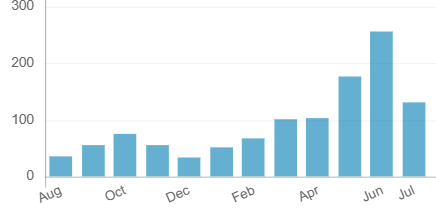
Additionally, Garrad & Nolan (2023) found that, during their implementation of the fully asynchronous UDL course (see Figure 1 on right), students demonstrated higher engagement and lower dropout rates over time. The rising amount of content downloads meant that diverse learner’s needs were being met and reused more frequently. By including more UDL principles into making digital courses more inclusive, educators can make learning more accessible and engaging for all students.
Overall, implementing accessible and inclusive design practices in UDL principles promotes a strong and engaging digital learning environment where all students can participate meaningfully and succeed.
References
Andersen, N., (2024). Enhancing Inclusion, Diversity, Equity and Accessibility (IDEA) in Open Textbook Publishing: The Development of a Guide. Open Praxis, 16(4), 677–686.
Garrad, T. A., & Nolan, H. (2023). Rethinking higher education unit design: Embedding universal design for learning in online studies. Student Success, 14(1), 1-8. https://doi.org/10.5204/ssj.2300
Ismailov, M., & Chiu, T. K. F. (2022). Catering to Inclusion and Diversity With Universal Design for Learning in Asynchronous Online Education: A Self-Determination Theory Perspective. Frontiers in psychology, 13, 819884. https://doi.org/10.3389/fpsyg.2022.819884
Jimerson, S. R., Allen, J. P., Arora, P., Blake, J. J., Canivez, G. L., Chambers, C., … & Yang, C. (2024). Advancing diversity, equity, and inclusion in school psychology science and scholarship: Changing training and practice in the field of school psychology. Canadian Journal of School Psychology, 39(4), 338-356. https://doi.org/10.1177/08295735241266746
Solovieva, T. I., & Bock, J. M. (2014). Monitoring for Accessibility and University Websites: Meeting the Needs of People with Disabilities. Journal of Postsecondary Education and Disability, 27(2), 113–127.
“Hey Bashar, I thought this was a nice read about OERs and what resource you’ve found. What made you choose Athabasca University website for an OER? I know that University of Victoria also has a range of materials available for students. I think that the open-access textbook you chose sounds like a great resource for beginners, especially with how it combines theory with practice. I think that the hand-on approach definitely supports the ICAP framework and might promote the learner’s problem-solving skills and/or creativity skills through the hands-on projects. Overall, this was a great read and I found it fascinating that even I could access the book you shared. I think it really shows how accessible these platforms and resources really are.”
“Hey Nico, I really enjoyed reading your post about PhET. I like how you shared your personal experience and how the visuals and simulations helped you better understand complex topics, especially when it comes to doing work around math and other complex concepts. I’ve also experience times when I needed a visual walkthrough of how to use some type of software or any new thing. I think you did a great job connecting your experience with the website to Merrill’s principles too where the whole basis of interactivity and how it can be used a learning tool can make a big difference! Overall, I thought this was a great read and a nice example of how OERs can make learning more engaging and accessible.”
“Hey Hanna, I enjoyed reading about your post about Khan Academy! I also used it back in high school for math and I totally get what you mean about how their use of a whiteboard made things easier to understand. It felt like he was a teacher explaining things to me in a visual way. I thought that you explained how accessible the website is and how breaking things down concept by concept can make difficult concepts easier to understand. Moreover, I think that you’re definitely right about how the website can be used to explain these concepts in a clearer way. Overall, this was a relatable post and a great choice for an OER.”
“Hey Emma, I loved reading your post about the Open Music Theory OER! I think it’s such a cool resource and it was so easy to access each section, especially with how it supports both creativity and learning at the same time. I can see how it connects to the ICAP framework because it definitely makes a lot of sense how a learner can digest material from just reading about theory to actually applying it in their own composition writing. I used to play the bass and ,like Isaac, I also wish I knew about this when I was younger. Moreover, I think that it’s great that you pointed out how the material can be used by different types of learners and adapt to different teaching styles. Overall, this was a really unique website and I’m glad I read your post about it so even curious people like, can look through it!”
An open educational resource that I found impactful was Coursera. It’s an open educational platform that offers both free and paid courses from different universities and organizations. Most of the courses are free and allow for others to reuse and redistribute the material, which makes it easy for people to access quality learning materials without barriers. I find it impactful because it uses different types of multimedia and interactive materials that ensures the learners are engaged and proactive about their learning journey.
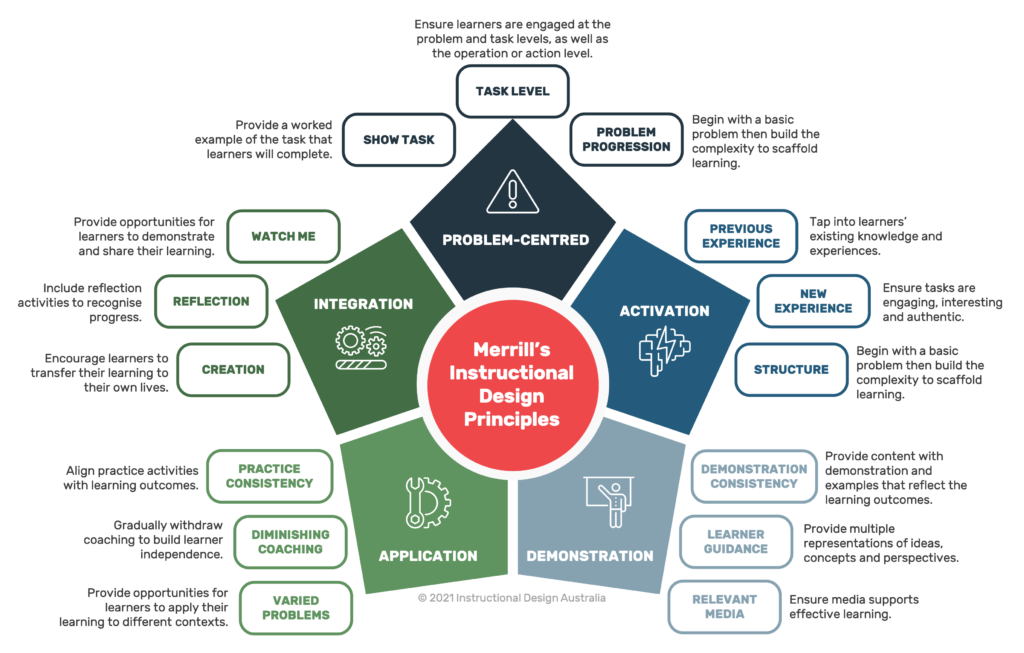
Figure 1. Merrill’s Instructional Design Principles. Adapted from First Principles of Instruction (Merrill, 2002, 2007); image from Instructional Design Australia via Discover Learning Australia (2021).
The platform starts the learners with what they know already before going into demonstrations through videos and/or real world examples. For instance, the instructors start with short review quizzes or reflection questions to recall any prior knowledge before introducing new material and then proceeding to show video demonstrations or case studies. They begin with active learning to see what the learners knows, however this may vary depending what course the learner chose. Thus learners apply what they learned through the practice exercises by discussing their new skills in forums or quizzes. As shown on Figure 1., there is a cycle of activating, then demonstrating, applying, and integrating what the learner gained throughout the course. Likewise, it also mimics the ICAP framework where deeper engagement happens when learners transition from passive learning to interactive learning (Chi & Wylie, 2014). Coursera offers feedback, forums, and group projects as part of their interactive learning. As for the accessibility, Coursera follows the UDL principles through having transcripts, captions, adjustable playback speed, and mobile accessibility for a diverse range of learners.
Overall, the platform continues to be a great resource for education for any learner wanting to delve into new material and have the same opportunity without any barriers.
References
Chi, M. T., & Wylie, R. (2014). The ICAP framework: Linking cognitive engagement to active learning outcomes. Educational psychologist, 49(4), 219-243.
Merrill, M. D. (2002). First principles of instruction. Educational Technology Research and Development, 50(3), 43-59. SpringerLink+2ERIC+2
Merrill, M. D. (2007). First principles of instruction: A synthesis. In R. A. Reiser & J. V. Dempsey (Eds.), Trends and issues in instructional design and technology (2nd ed., Vol.2, pp. 62-71). Merrill/Prentice Hall.
“Hey! I really liked reading your reflection on the design process. I thought it was really creative how you described it as a loop instead of a straight line. It makes a lot of sense how you connected the Double Diamond model with Backward Design since both focus on exploring ideas first and then narrowing them down with a clear purpose in mind. I liked how you mentioned that design isn’t just about getting to a perfect endpoint but about learning and improving through feedback.
Your Challenge A reflection was really meaningful, especially how you used your comic to help children with developmental disabilities understand and express emotions. Simplifying your panels and focusing on empathy over detail showed a strong understanding of clarity and connection with your audience.
For Challenge B, I liked how you applied what you learned from Challenge A and used it to design mindfulness videos. It’s great how you’re combining creativity with practical skills like editing and file management. You could maybe expand a bit on how feedback shaped your revisions, but overall, your reflection showed a strong sense of growth and purpose. I can tell you’re really developing your design voice and confidence!”
“Hey! I really enjoyed reading your reflection on the design process because it was clear and structured, and even provided a picture that breaks down the stages from defining the problem to implementing the final product. I thought it was cool how you described moving from a sequential process to an interactive one by revisiting your prototype after peer feedback, showing a strong understanding of how design is about refining ideas rather than completing them in a single go.
Your reflection on teamwork was also thoughtful because you recognized that each member in your learning pod had both strengths and weaknesses, suggesting a better way to divide work for future projects (Challenge C). In the early stages, our team used divergent thinking by exploring different aspects like visuals and text for the prototype, and now you are aiming for a more convergent approach that brings those ideas together into a cohesive final product.
If you wanted to expand your post, you could connect your design choices to backward design by considering your target audience and how you planned each step to reach that goal. I think you also improved a lot from your last post by adding more multimedia, pictures, and content. I am also really happy to be in your learning pod because you, me, and Raj collaborated well and met all deadlines.”
“Hey! I like that you’re focusing more on iteration and teamwork this time. It’s great that you’re using feedback throughout the process instead of just at the end. You could even connect this idea to backward design which thinks about your goal from the start and checks if each version supports it. I also thought it was really honest and reflective how you mentioned working in a silo during Challenge A. Noticing that limited feedback led to higher cognitive load shows a good awareness of how important collaboration and user perspective are.
Overall, your post shows a lot of growth and understanding of how design is a continuous learning process.”
“Hey! I thought your Challenge A reflection was great because you chose a character-driven story to explain dispersion instead of just using diagrams was a smart move. It made your idea more engaging and easier to understand. I also liked how you used peer feedback to make your comic more dynamic, like splitting the color reveal into multiple panels. For Challenge B, it’s awesome how you’re applying the same process with your group. Testing scripts and aligning visuals with narration sounds like a solid plan, and it’s great that you’re building on what you learned from Challenge A. The way you connected everything to the Double Diamond model tied your reflection together really well. Overall, your post showed creativity, growth, and a strong grasp of how good design takes time and iteration!”
A design process is a sequence of actions that the creator/developer or anyone uses to create, test, and refine a product or learning material in order to result in an outcome or a goal in mind (Jonassen, 2008). It usually is an interactive process where it is similar to design thinking which includes empathy, defining, ideate, prototype, and testing a product (Shé et al., 2022). Much like the divergent and convergent thinking, the design process involves planning, prototyping, testing, feedback, and revision. Convergent and divergent thinking creates an opportunity to be creative and brainstorm, and then narrowing them down into concrete choices and decisions that helps the individual one step closer to their project’s goals (Wigert et al., 2022). In learning design, it also connects to backward design where you start with what you want your audience to understand and do, and then plan backwards to make sure that every step has a clear purpose and outcome (Reynolds &Kearns, 2017).
Challenge A
With that being said, my process in Challenge A: Comics was to create something that showed passion, hard work, and whimsy while keeping in mind “Why I was making this? Who I was making it for”, and “What did I want my audience to learn?” During the process, however, I found that exercising iteration such as reading the comic over a period of a few days and reviewing it with a fresh mind allowed for more ideas of improvements in which I could incorporate more multimedia design principles and/or drive my goal of wanting a fun and educational comic. In hindsight, I could have shown the dish’s progression better by gradually darkening the pot or background. The arrows felt unclear, and I struggled to make the panels flow intuitively without relying solely on them.
Challenge B
For Challenge B, I applied the backward design from the start where I identified the goal: teaching kids to exercise healthy habits from handwashing and then shaping the narration and visuals around the topic and my audience. I kept the educational and fun theme but added more energy through narration, which let me emphasize tone and apply multimedia principles like captions and sound effects. The kid-friendly narration and simple visuals make the video engaging and easy to follow for children learning about handwashing, which supports my goal and gives rise to the theories learned in class. Overall, I enjoy the design process and feedback because it allows me to be engaged with an audience while delivering the information I’m trying to convey, which makes the final product more thoughtful and effective.
Related Resource
Below is a great podcast and quote about design for learning and how educators can create more engaging learning experiences! Click here or the link below to explore the episode and read the full transcript.
“Good design shouldn’t have to be explained.” – Bonni Stachowiak [00:11:47]
Jonassen, D. H. (2008). Instructional design as design problem solving:An iterative process. Educational Technology, 21-26.
Reynolds, H. L., & Kearns, K. D. (2017). A planning tool for incorporating backward design, active learning, and authentic assessment in the college classroom. College Teaching, 65(1), 17-27.
Shé, C. N., Farrell, O., Brunton, J., & Costello, E. (2022). Integrating design thinking into instructional design: The# OpenTeach case study. Australasian Journal of Educational Technology, 38(1), 33-52.
Wigert, B. G., Murugavel, V. R., & Reiter-Palmon, R. (2022). The utility of divergent and convergent thinking in the problem construction processes during creative problem-solving. Psychology of Aesthetics, Creativity, and the Arts.
This blog post is a documentation of the process we underwent to create three 1-minute videos about our topic. This learning pod is composed of three members: Bashar Kabd, Raj Aarya, and Therese Taruc. We chose this topic because we were all familiar with it from a young age, and we wanted to explore hand hygiene in more detail as part of our project. Our goal is to expand our knowledge about the topic by explaining it in a quick and concise way. Overall, we are excited to see what we find, and how our videos turn out in the end.
THE PROCESS
Understand (Discover, Interpret, Specify)
DESCRIBE THE CHALLENGE:
Elementary school children need to learn the importance of proper handwashing techniques to protect themselves and others from spreading germs and illnesses. This helps them stay healthy, reduce the spread of illness and diseases, and they feel confident in taking responsibility for their hygiene.
CONTEXT AND AUDIENCE:
Audience
A typical audience is made up of elementary-school students (aged 5-12 years old). Students will be able to watch the video as part of class assignments or in-class activities and possibly as part of a guest speakers activity. Some extreme audience cases include students with learning difficulties, as well as visual or auditory problems.
Needs
Elementary school students completing this assignment or activity will need to watch over the videos and demonstrate their ability to wash their hands from start to finish. For students with hearing problems, the video can be uploaded to youtube, and captions can be shown. For students with sight problems, the guest speaker or teacher can provide the students with a verbal description of certain steps, as well as help the student practice hand washing. For students with learning difficulties, the task can be broken down into smaller and easy to digest steps, and explained in a simplified way.
The goal for the students is to complete the assignment or activity and learn how to wash their hands at the bathroom sink without assistance. This will help them develop better hygienic habits, reduce likelihood of sickness, and stay clean. Moreover, the elementary schoolers will get closer to their classmates as they learn to wash their hands together during the activity.
Motivations
Students will feel motivated to complete the assignments for a handful of reasons. The first is that the videos will be designed to be appealing to elementary-schoolers. There will be colorful graphics and simple narration. The second reason is that students will enjoy completing the activity with their friends.
POV STATEMENT:
An elementary school student needs to learn healthy handwashing habits through clear, step-by-step instructions so they can stay healthy, prevent the spread of germs, protect both themselves and their friends, and promote a clean, healthy classroom environment.
LEARNING OBJECTIVES:
Primary Objectives
1. Healthy habits
Students will learn when handwashing is necessary (e.g., before eating, after bathroom use, after coughing/sneezing)
Students can follow clear, step-by-step instructions to wash their hands correctly
2. Health awareness
Students will understand the importance of handwashing to prevent the spread of germs and illnesses
Students can recognize how personal hygiene affects their both their health and the health of their classmates
Sub-Objectives
Students can feel motivated to wash hands regularly because the activity is presented in a fun and engaging way
Students can develop a positive attitude towards personal hygiene and incorporate their hand hygiene even outside of the classroom thereby promoting lifelong healthy practices
The main objective of the brainstorming stage was to find different types of methods through which we can make the concept of hand hygiene both easy to understand and visually engaging for the students in elementary school. We found various resources highlighting the importance of handwashing practice, but the ones that stood out to us were the Centers for Disease Control and Prevention (CDC) and the World Health Organization (WHO), which provided the foundation for proper handwashing steps. Other than written resources, we dove into the educational short videos designed for the children, as well as the posters and charts in the classrooms on the topic of hand hygiene. These resources highlighted effective strategies, such as colorful visuals and demonstrations, while avoiding common mistakes like overloading information or using technical terms that are hard to understand. From this process emerged three potential prototypes:
Instructional video: a short and straightforward video/tutorial teaching the correct handwashing techniques to students.
Scenario-based vide: a short story with the main character in the centre explaining the importance of hand hygiene.
Explanatory Video: a small approach with animations and playful script, which explains why hand-washing matters by visually showing germs, and each step will come with narration and adequate visual cues.
The most promising prototype that we found is the explanatory video, because this type of video is the combination of engaging visuals and narration, with clear step-by-step information that makes the information easy to understand. This approach also reinforces the importance of hand-washing practice with clear guidelines, helping to build understanding and motivation among elementary school students.
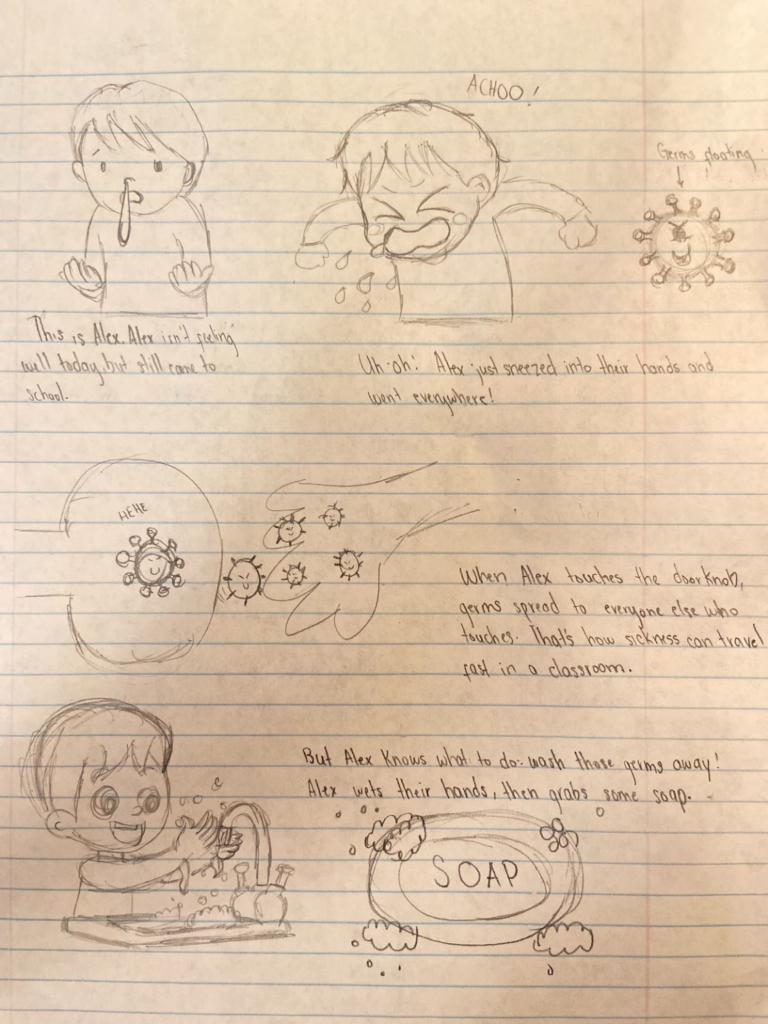
(SCENARIO): “Alex and Handwashing”
SCRIPT
Sniffly and sick Alex
Narrator: “This is Alex. Alex isn’t feeling very well today, but still came to school.”
Alex sneezes into his hand
Narrator:“Uh oh! Alex just sneezed into their hands!”
Alex touches a doorknob and germs can be seen attaching
Narrator:“When Alex touches the doorknob, germs spread to everyone else who touches it. That’s how sickness can travel fast in a classroom.”
Alex at sink doing step-by-step handwashing at the sink on a chair (maybe he’s small)
Narrator:“But Alex knows what to do: wash those germs away! Alex, wets his hands then adds some soap. He scrubs the soap all over his hands. Palms, back of hands, between fingers, and even under his nails. After scrubbing well, Alex rinses off all the bubbles with clean water. Finally, Alex turns off the tap and dries his hands with a fresh towel.”
Alex in classroom with other students
Narrator:“Now Alex’s hands are squeaky clean! By washing your hands, you protect yourself and your classmates, which helps everyone stay healthy and enjoy a safe, happy classroom.”
STORYBOARD
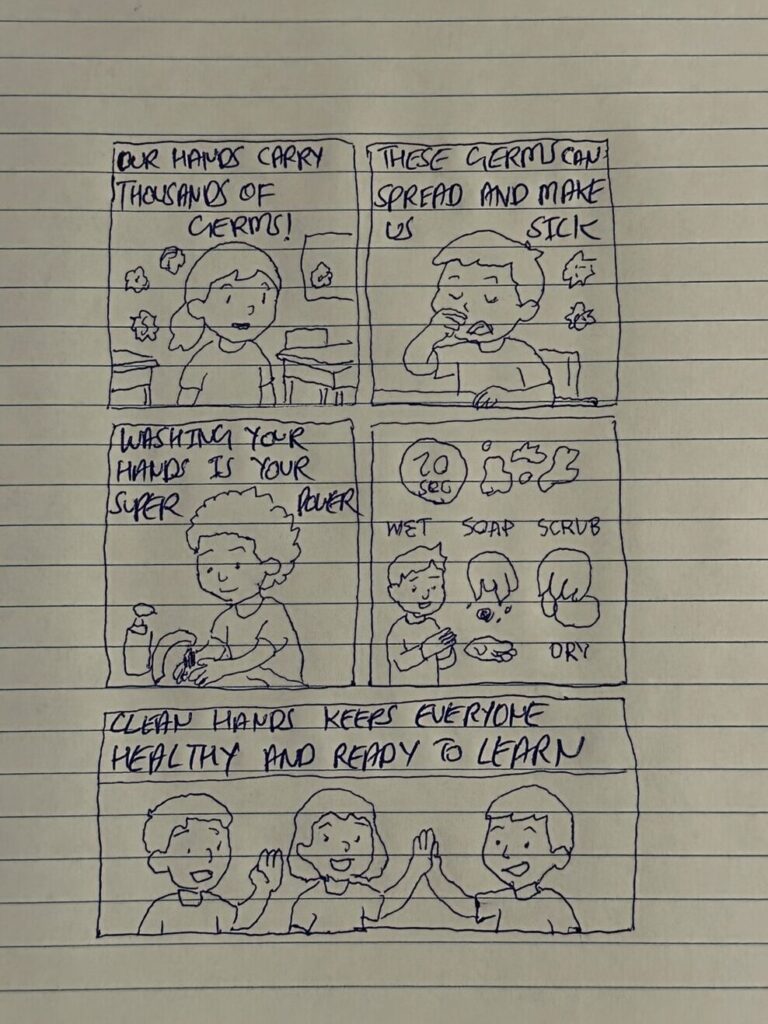
(EXPLANATORY): “The Power of Clean Hands!”
SCRIPT & STORYBOARD
Scene 1 – The Background is a classroom; animated germs are moving around in the space above the children. Narrator: “Did you know that our hands can carry thousands of invisible germs? They travel with us everywhere—on doorknobs, desks, and even our phones!”
Scene 2– one of the students starts sneezing and touching the desk. Narrator: “When we don’t wash our hands, these germs can spread and make us or others sick.”
Scene 3- Then the child stands up and goes to the sink. Narrator: “But washing your hands properly is like having a superpower—it can stop germs in their tracks!”
Scene 4- an animated picture/chart comes up showing 5 steps of hand washing: Wet – Soap – Scrub – Rinse – Dry. Narrator: “Just wet your hands, add soap, scrub for 20 seconds, rinse well, and dry completely.”
Scene 5- students in the classroom feel happy and start high-fiving each other. Narrator: “Clean hands keep everyone healthy, happy, and ready to learn!”
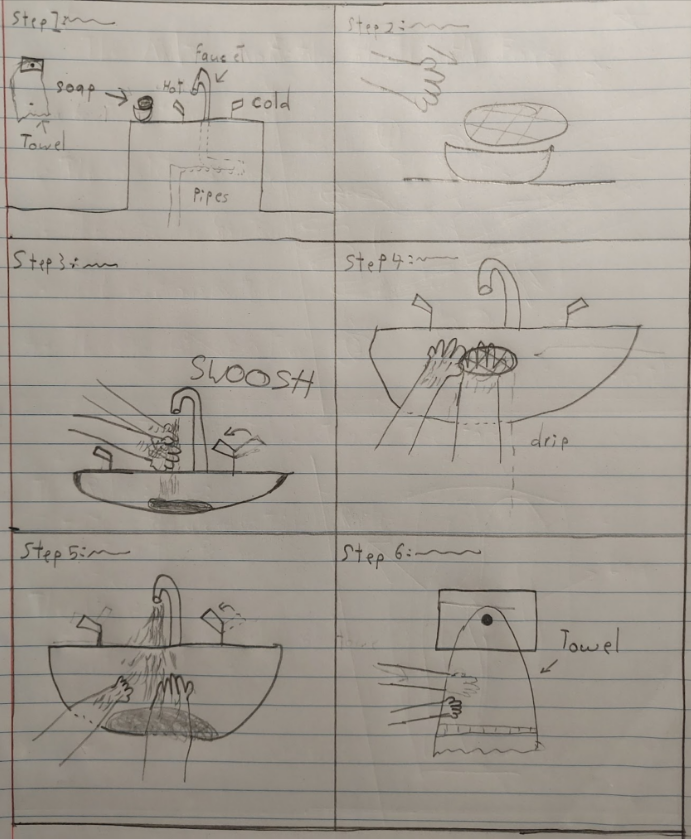
(HOW-TO): “How to Wash Your Hands: a Tutorial”
SCRIPT & STORYBOARD
Step 1: Approach the nearest sink (with soap and running water available)
Step 2: Grab the soap
Step 3: Wet your hands
Step 4: Rub soap all over your hands
Step 5: Run water over your hand until there is no more soap
Step 6: Dry your hands with a towel
PRINCIPLES APPLIED:
Coherence and Signaling Principle
We used coherence principle to guide and ensure that each video avoided unnecessary information, sounds, and visuals so that the view can focus on the key message. In Alex and Handwashing, only relevant narration and simple animations are included, while avoiding background distractions. In one of the scenes, it is shown that the hand washing techniques are numbered thereby applying the signaling principles to guide the viewer the proper correct sequence of handwashing actions. By maintaining coherence and using clear signals such as the visual cues, these can support learners in processing information in a clear, structured manner where the viewer’s cognitive process and extraneous load is reduced and efficiently used (Ragazou & Karasavvidis, 2023).
Segmenting Principle
Narration and visuals are presented at the same time in order to reinforce the viewer’s understanding of handwashing. In Alex and Handwashing, the narration about “scrubbing between fingers and under nails” appears right as Alex begins to perform those actions. All across the videos, concepts are segmented into parts where the story is divided into clear, logical steps. These include: introducing the character (Alex) and problem (germs), providing a solution (washing), and showing the outcomes (clean hands and classroom). This chunking makes the process easier for learners to follow and retain the concept and material (Mayer et al., 2019). Through demonstrating the sequence of actions, the viewer can build understanding step-by-step, which will help them recall and perform the proper washing habits.
Personalization and Redundancy Principle
The other two principles that helped us positively in making our video were the personalization and redundancy principles. To increase engagement and motivation among our young audience from elementary school, we used a friendly and soft conversational tone. “You can be a handwashing hero!” is one of the examples used in the video, which helps to build an emotional connection between both the viewer and the content, which, as a result, encourages active participation. We also took steps to avoid redundant on screen-text, which might be negatively impacting the narration, but instead we used visual cues such as “Wet – Soap – Scrub – Rinse – Dry” to reinforce the main idea without cognitively overwhelming the learners. These strategies completely fall under the recommendation by Mayer (2019), which uses the text to add value, not to just repeat the narration.
Multimedia Principle
The Multimedia principle overviewed our overall design, the intentional use of words and visuals to enhance the engagement and understanding of our topic. In the video, there was a scene where the narrator talks about staying healthy, and in the background, germs started to disappear. This can help learners connect cause and effect more easily and efficiently. To make the learners’ experience enjoyable and memorable, we used a combination of animated images, voiceovers, and cheerful background music. Together, these principles helped us to ensure that our project was educational and grounded in evidence-based learning strategies that promote lasting behavioural changes.
Peer Feedback
Neeraj
In the feedback given by Alexis Moore, our group has the strong knowledge of the principles of Mayer’s Multimedia learning principles and we implemented them throughout the videos. She also highlighted that our blog post shows good organisation and we connected the principles of multimedia such as coherence, signaling, segmenting, and personalization to our story boards smoothly. Alexis also liked the fact that our topic is very simple yet equally important. She notices that the nature of our topic is very clearly suited for our targeted audience including young children which is an important age group for developing healthy hygiene habits.
Alexis suggested that we should add a reflective prompt in a question format asking “how many times do you wash your hands” to make it more memorable and engaging for students. It can also be reflective as it will allow students to reflect on their own hygiene practices and habits. This suggestion is influenced by the principles of personalization and generative learning as it prompts an active reflection.
Bashar Kabd
According to Ali Raffi, my portion of the blog post had multiple strengths, as well as some areas of improvement. For strengths, Ali Raffi found the visuals clear and engaging for the target audience, as well as easy to follow for elementary students. Multimedia principles have been applied to my video in a thoughtful manner. For weaknesses, my video lacked an introduction that explains why handwashing is good, and I did not have a diverse list of characters in my video (one character).
According to Yiran Han, My storyboard reflects strong alignment with Mayer’s multimedia principles. Namely the segmenting, coherence, and personalization principles, which reduced cognitive load and increased engagement. On another note, Yiran Han also suggested improving the blog post by introducing my How-to video in a way that connects it to the other two videos. Furthermore, Yiran Han suggested making the video more inclusive by adjusting narration speed, among other things to help learners with accessibility issues.
Therese Taruc
The feedback we received highlights that our prototype caters to our audience (elementary learners) and task by using a short and step-by-step kind of videos with clear narration and simple visuals. It acknowledges coherence, segmenting, and other multimedia learning principles. Likewise, it was highlighted that it can be accessible for learners with hearing and vision needs. The feedback suggests adding a visual timer or progress ring to show the 20 seconds of scrubbing. They also suggested maintaining consistent camera framing and steady motion, and adding brief checks that reinforce key steps.
The second feedback emphasized that our prototype was clear and engaging which properly teaches elementary students through animated visuals and clear narration. The videos were effective in using coherence, signaling, and segmentation principles while keeping accessibility features like captions and guidance for diverse learners. The peer suggested slightly slowing down the pacing of sequences to give learners more time to process each step and to maintain the same colors and animation style across all videos for visual coherence. They also suggested adding a short recap at the end of each video.
PROTOTYPES
“Alex and Handwashing”
Video By: Therese Taruc
“The Power of Clean Hands!“
Video By: Raj Aarya
“Step-By-Step Handwashing Techniques”
Video By: Bashar Kabd
FINAL PRODUCT
Reflect and Refine
TEAM REFLECTION:
Some of the things that worked well for us were the application of multimedia principles in our blog post. The peer reviewer also approved of our use of the segmenting and coherence principles. With that being said, there are some areas of improvement that we can focus on. Mainly, the reviewers suggested making our prototypes more accessible for students with learning difficulties, as well as make our prototypes flow together more cohesively.
Some revisions we included in our revised prototype included making the How-to video simpler by adding a timer to display how long washing hands takes. Furthermore, another revision is stabilising the camera, as to reduce motion blur and make viewing easier.
There were several key issues raised by my peers in peer feedback, which helped me to understand more deeply the consequences of the decision on the learning outcomes. One of the areas that was highlighted in the feedback was to ensure accessibility for diverse learners, such as learners who have visual or cognitive challenges. One of the resources that I capitalized on was the use of captions and clear narrations, but groupmates recommended using more explicit visual cues or using a timer when showing the tutorial for handwashing to ensure that learners were guided throughout the 20-second handwashing process. I made sure to reinforce this idea by adding a special visual cue in my video during the handwashing process, highlighting the five steps of handwashing. Other feedback I found interesting was on the issue of cohesion between all videos; there were variations in colors and styles among them. To solve this issue, I used resources such as consistent background music and color themes with easy-going narration to ensure a smoother and engaging learning experience.
One of the strengths of these types of multimedia for learning is that they clearly and strongly align with the principles of Mayer’s Cognitive Theory of Multimedia Learning (CTML). The help of resources like clear narration, animations, engaging visuals, and cheerful background music in our multimedia project helped us to reduce cognitive load and maintain the learner’s engagement. We used the principles of coherence, signaling, and segmenting in our videos to reduce the use of excess information and to make sure that learners can easily focus on the main content without any distractions. One example would be that we used easy-to-understand visual cues like “Wet – Soap – Scrub – Rinse – Dry” for two main reasons: to help learners follow every step and to reduce redundant on-screen text.
One of the limitations of this type of multimedia is to ensure a great balance between entertainment and educational clarity. If there is an excessive use of visual cues or background music, it can easily distract the learners from the main idea we are trying to convey. Also, the fact that not all learners may process the information or visual cues at the same speed, so there has to be adaptive pacing or interactive features to make it inclusive even for well-designed multimedia. For this specific problem, we can use the segmenting principle as explained by Mayer et al.(2019), that using segmenting learning content into smaller chunks of information can allow learners to control their pace and process information in their own way more effectively.
INDIVIDUAL REFLECTIONS:
Neeraj
In this group project, every member of the group was responsible for making their own Script, Storyboard, and Video. We divided the main idea into three parts, and each group member took one part each. Additionally, we all provided each other with valuable feedback regarding our videos and shared ideas as well. I completed ideation, and I also co-wrote the sections on Principles Applied and team reflection with Therese. Finally, I completed individual reflection. For projects like this in the future, I would recommend using a clear structure highlighting each team member’s responsibilities. Also, it would be great for team communication if we create a page with the assignment for notes and updates.
Bashar Kabd
I completed the Introduction for Phase 0, and chose the background color for the blog post. Additionally, I completed the Context and Audience sections for Phase 1. I completed my storyboard and script, prototype, and video for Phase 3. I also completed two Peer Reviews for Phase 4, and contributed to half of the Team Reflection for Phase 5.
Therese Taruc
For this project, every member made a script, video, and storyboard. I contributed on: Providing the topic, describing the Challenge, POV statement, learning objectives, co-wrote Principles Applied with Neeraj, individual and peer review reflections, formatting of the website, and dividing the work between members. Bashar contributed with: Context and Audience, Peer Feedback, Team and Individual Reflection, and visuals of the website. Neeraj contributed with: Ideation, Principles Applied, and Team and Individual Reflection. Our teamwork was organized, had effective communication, and excellent with meeting team deadlines and expectations. For future projects, we could improve by planning and scheduling group meetings through Zoom rather than relying on text (Instagram). Miscommunications can occur when responsibilities or updates are made through messages, especially if a team member is unavailable at the time. Having a live discussion would allow us to clarify our tasks and goals to ensure everyone understands the plan and address any possible questions in real time. Overall, the team was effective and demonstrated a strong collaborative environment.
REFERENCES
Mayer, R. E., Wells, A., Parong, J., & Howarth, J. T. (2019). Learner control of the pacing of an online slideshow lesson: Does segmenting help? Applied Cognitive Psychology, 33(5), 930–935. https://doi.org/10.1002/acp.3560
Mayer, R. E., Wells, A., Parong, J., & Howarth, J. T. (2019). Learner control of the pacing of an online slideshow lesson: Does segmenting help? Applied Cognitive Psychology, 33(5), 930–935. https://doi.org/10.1002/acp.3560
Ragazou, V., & Karasavvidis, I. (2023). Effects of signaling and practice types in video-based software training. Education Sciences, 13(6), 1–14. https://doi.org/10.3390/educsci13060602
“Hi Bashar! It was fascinating reading your blog post. I’ve never heard of Arduino before. I thought you did a great job with talking about the hardware components and breaking it down, then showing how they all work together. I think that concrete scenario really supports your point about reducing intrinsic load because it simplifies a really abstract system. I thought that when you connected segmentation and reducing extraneous load was strong because the information was broken into smaller and logically ordered segments. However, I worry that the post only highlights the benefits of Arduino and doesn’t consider or mention some potential challenges learners might face. For example, are there situations where the hardware setup might become overwhelming for beginners even with the segmentation in the video? I think adding a bit of warning or note about this could make your post even more applicable and informative.
Overall, I think your post was very well-organized and demonstrated a clear connection between the video and the multimedia learning principles we learned!”
“Thanks for your blog post Yiran! I thought you did a great job showing how the video had different types of multimedia learning principles such as coherence and signaling. I especially liked how you pointed out the 6 functions of dreams and how the video segments them into clear and more digestible parts, which I thought made this complex topic much easier to follow. I thought that your observation regarding visual cues such as highlighted text and arrows helped direct the viewer’s attention to the key terms, thereby helping the viewer’s learning experience. As for the criticism, I wonder if you could maybe acknowledge and clarify that these theories are still being debated within neuroscience and psychology. I think that the video demonstrates multimedia learning principles clearly, however by addressing these debates and uncertainty regarding dreams can help make a deeper discussion about how learners can see information.
Overall, I think your post demonstrated how good multimedia design can really help a learner’s learning experience and help them digest potentially abstract theories and ideas into something that is less intimidating, and more approachable and engaging.”
“I thought your blog post was relatable and insightful with how connected your own experience of feeling lost with investing and the way this video simplified a seemingly daunting topic. I think that the personal connection you made resulted in your reflection in your blog post feeling more authentic and helped me see why the video resonated with you. I think the choice of video and the length itself was great, especially if the viewers such as yourself wanted something that discusses the basics of investing in the stock market before deciding which stock to invest in. I thought your analysis of Mayer’s principles was also strong. I enjoyed reading how the video talks about the Craigslist analogy and how it shows how personalization and relatability can help address the gaps between difficult theories or concepts and practical understanding. That example I think helped show how multimedia can reduce intrinsic cognitive load as well!
As for the criticism, I think supporting the theories you suggested with a peer-reviewed journal article would strengthen your claims even further. It would not only solidify your points in what you’ve learned about the multimedia learning principles and theories, but it would also show how the video aligns with existing studies on multimedia learning. I think it would add an extra layer of depth to an already engaging blog post.
Overall, you did an excellent job at discussing the topic and how the video demonstrates the theories we’ve learned in class. Thanks for a nice read Devin!”
“Hey Simon! Thanks for sharing your substantive post. Upon first reading your topic, I immediately thought of Warhammer. Have you ever heard of that game? I know a few who play this and the lore of the game reminds me of this topic regarding wars between different civilizations, or in their case, factions amongst monsters. Likewise, it also touches on politics, technological advancements, and war like you mentioned. If you haven’t heard of the game, it could be something you might be interested in! In regards to the video, I thought it was very cool that they included aliens and monsters to convey the characters and who may/may not be involved in these wars. In your reflection about Mayer’s principles, I thought you had a great point about how the video uses segmenting and breaking down such an overwhelming concept and compared Earth-like weapons to a galaxy-scale scenario. I think that people who are not familiar with sci-fi and fantasy will have a better understanding of this through relating sci-fi elements into our everyday lives.
As for the criticism, I wonder if you could also consider the potential risk of the video’s oversimplification of the concept. While the video uses colorful animation and humor throughout, some of the viewers might take the content more literally than intended. I think addressing that balance could strengthen your analysis!
Overall, I thought it was a really engaging post. I enjoyed watching the video as well and how in-depth they discussed such an imaginative topic.”
“Hey Neeraj! I liked reading your post about the TED-Ed video about “How Stress Affects Your Brain” You did a great job explaining how Mayer’s multimedia principles apply to the video. I like how you connected the modality and coherence principle to specific examples like the release of cortisol and avoiding any distracting text. Personally, I thought it made your analysis accurate and easier to follow. I found it interesting how you highlighted the personalization principle in the ending section and linked the content to everyday life, which made your reflection more engaging and relatable.
I think that some sentences could be improved for your analysis so that it’s stronger. For example, you could expand a bit more about how coherence and modality principles improve learner comprehension, rather than saying that they’re being used. I think you could add a short anecdote (if you’re comfortable) about your own learning experience while watching the video. For example, saying what helped you understand stress and why. I think this could strengthen the personal connection to the theories and content in your post.
“Hey Hailey, your post stood out because of how clearly you explained pretraining, segmenting, and the modality principles within the context of the video. I especially liked how you connected the pertaining principle to the introduction of colour terminology. I thought that this explanation made the concept easy to visualize and helped me see how foundational knowledge reduces cognitive load. I liked that your writing was organized into short and focused sections that mirror the segmentation principle itself. It makes your analysis easy to follow and reinforces the exact principles you were talking about.
I wonder if you could explain further on why these design choices make learning more effective for viewers such as how pairing narration and visuals together can help learners process abstract film concepts or how segmentation might support long-term retention. I think everything was pretty well written and I love the pictures you’ve added to support each heading to solidify its importance and relevance.
Overall, your analysis was thoughtful and interesting to look at and read.”
In this week’s substantive post, I watched a NOVA PBS Documentary on “Your Brain: Who’s in Control?” The documentary delves into how much of our behaviour such as actions and decisions is controlled by our subconscious brain processes. The video shows the brain activity and actions of patients who sleepwalk, have undergone split-brain surgery, and how people experience and react to emotions and trauma. The video goes into how much of ourselves is truly governed by “us” or our brain. I thought that this was impactful because it challenges our perception of free will and control. By showing our actions can be driven by automatic functions of the brain rather than voluntary choice, the documentary sparks a curiosity within the viewer of what it means to make decisions and how to form or change habits.
Use of Multimedia Design
The documentary is a clear example of how to combine modalities for deeper learning where the video shows both narration and interviews with visuals such as brain scans, animations, and behavioural experiments. It allows for the views to process the content in dual channels: auditory and visual channels, evidently reducing cognitive overload and reinforcing meaning. Likewise, the video shows animations of neurons firing or brain regions lighting up, while the narrator describes what’s happening rather than repeating text and paragraphs. This helped make a clearer mental model of how the brain works and reinforced the idea of dual channels. Lastly, the video used chapters and segmented each topic (sleepwalking, emotion, trauma) through visual cues so that the viewer can follow the flow and slowly unravel more information. Through the use of this coherence and signaling, the content is focused on key findings and observations.
Overall, the documentary educates the viewers about the brain’s complex processes, but also demonstrates how effective multimedia design can help difficult concepts be more engaging and memorable.
Related Resource
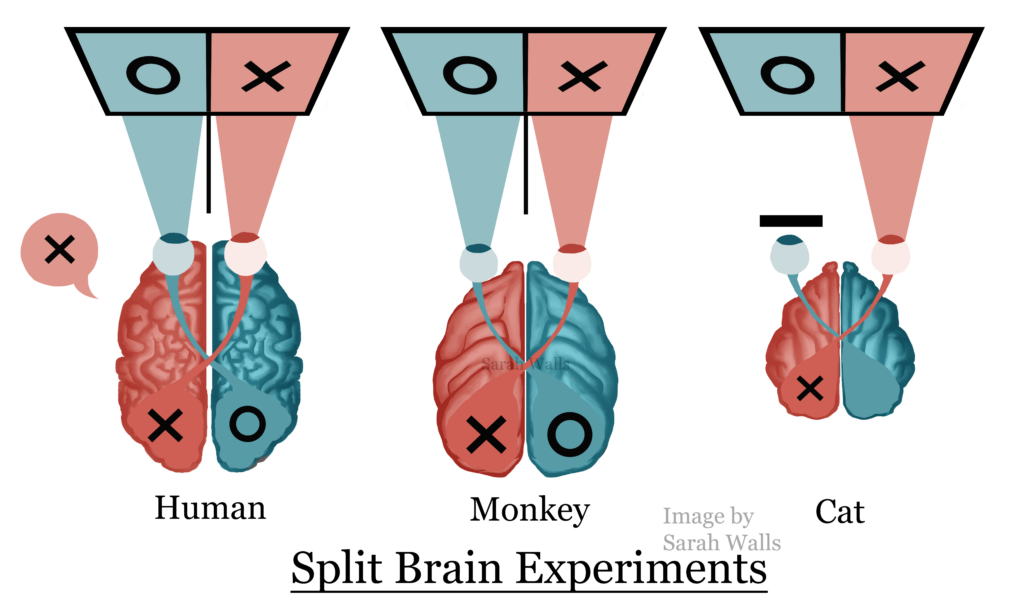
If you’re interested in learning more about the brain, I found this excellent article on Roger Sperry’s Split Brain Experiments where he talks about the hemispheres of our brains function independently after a part of the brain (corpus callosum) is severed. Figure 1. from the article shows exactly what our left and brain hemispheres “see”, how they communicate with each other, and convey information. The article expands more about what the narrator discussed and showed in the video above regarding patients who underwent a Split Brain surgery!
Figure 1. Illustration of Roger Sperry’s split-brain experiments in humans, monkeys, and cats (1959–1968). Note. Adapted from “Roger Sperry’s Split Brain Experiments (1959–1968),” by S. Walls, 2022, Embryo Project Encyclopedia. Arizona State University. https://embryo.asu.edu/pages/roger-sperrys-split-brain-experiments-1959-1968-0